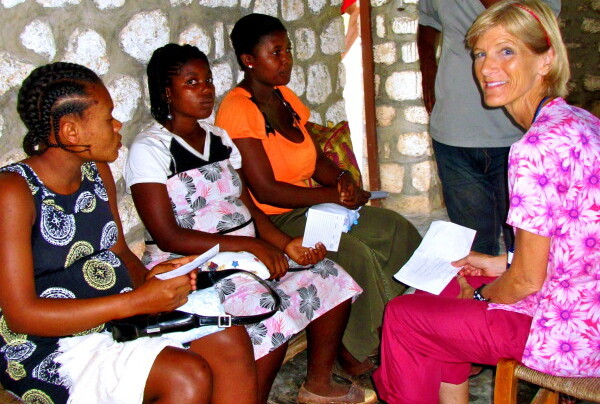
Last September, Susan Sheridan, director of the Nebraska Center for Research on Children, Youth, Families & Schools, traveled to Haiti for a two-week mission trip.
Once there, she spent the bulk of her time in La Montagne. Meaning “the mountain” in Haitian Creole, this rural region is a far cry from the bustling cities of Jacmel and Port-au-Prince.
“La Montagne is up on the mountain range and it’s hard to get there because the roads were pretty much decimated and torn apart,” Sheridan said.
This destruction is in part due to last year’s 7.0 magnitude earthquake that left most of the Caribbean country in ruins.
“Haiti did not have much of an infrastructure to begin with to really leverage a lot of the foreign relief efforts,” Sheridan said. “Without the infrastructure, the aid continued to be these piecemeal efforts.”
Sheridan said that she saw signs of reconstruction, but a lot of the rebuilding that has yet to take place is not just on highways and roads, but among the Haitian people.
“What really set this experience apart, relative to other experiences I’ve had abroad, is the very personal nature of it,” Sheridan said. “I was interacting with people on every level – from helping a parent bathe her child to administering medicine through a syringe to teaching pregnant women how to take care of themselves and their unborn babies.”
Sheridan has previously been to Zambia, Africa where she visited villages, spent time at the university and talked to administrators.
“In Zambia, I stayed in a nice hotel and had hot shower, which I didn’t have in Haiti,” Sheridan said. “But (in Zambia) I wasn’t working hands-on with people, trying to help them achieve their own goals and dreams the way I did in Haiti.”
Sheridan went to Haiti with Friends of the Children, a Wisconsin-based nonprofit organization that has provided biannual medical and dental care in rural parts of the country since 1998.
Sheridan’s sister, a registered nurse, and brother-in-law, an emergency department physician, serve on the organization’s board of directors.
“She told me these stories about Haiti with all of this vivid imagery and I knew that there was something really special going on there,” Sheridan said. “So that’s what sort of peaked my curiosity.”
Having familial connections to the organization and its purposes solidified Sheridan’s decision to make the trip.
“In the anticipation of the trip, I felt very comfortable and secure,” Sheridan said. “I knew going in that things would be well take care of and they were. This team had every detail down to a science.” Friends of the Children set up a makeshift clinic in an empty parish compound, where the church was converted into a triage unit.
In 14 days, the clinic saw 3,000 patients who were seeking care for an array of medical issues.
“People would come in with their hands almost completely severed from machete accidents,” Sheridan said. “My brother-in-law fixed up and sewed the skin of one victim who came back the following week and was moving his fingers. I keep thinking that if the accident happened a week after we left, that person probably would have had infection and gangrene set in – that could have been a life sentence.”
A trained psychologist, Sheridan’s experiences during the trip ranged from visiting educational administrators to teaching midwife classes to meeting with psychiatric patients.
Unbeknownst to his family, one local suffered from adult onset schizophrenia, leading his mother to believe that his behavior was the result of a demonic possession.
“His mother put him around a post with shackles around his ankles and wrists because he’d been out slashing his machete around and she thought the devil was in him,” Sheridan said. “Once they got him on the right anti-psychotic medication, I interviewed him and he was a completely different person. Now he’s working in the village and able to sustain a very independent lifestyle.”
That experience reinforced Sheridan’s faith in the power of education to transform lives in a quantifiable way.
“Education, education, education – that’s really all that it’s about,” Sheridan said. “We’re not trying to change their culture or minimalize their belief systems. We want to show that medicine and education can help them lead healthy lives.”
As director of the Nebraska Center for Research on Children, Youth, Families & Schools, Sheridan conducts research based on her interactions with educators and students in Nebraskan schools, specifically in rural areas of the state.
“My trip (to Haiti) aligns so well with what we’re doing here at the center,” Sheridan said. “We’re about reaching and exceeding potential and when we think about the potential of the Haitian people, it’s endless. With a little education, they can go so much further.”
Sheridan and the center are currently developing a mechanism through which people can donate money directly to the educational reform efforts in La Montagne. In the meantime, Sheridan said anyone who’s interested in contributing to her cause is welcome to contact her via phone or email.
“There’s really nobody who is focused on education reform in La Montagne,” Sheridan said. “I’m committed to using our resources to create opportunities for people to step up and help improve the state of education in Haiti, at least in this mountainside area of La Montagne where I stayed and did my work.”
Fifty percent of Haitian children do not attend school. Of that number, about 75 to 80 percent don’t make it past the sixth grade, largely because they have to fund their own schooling.
Ten dollars covers the costs of materials for a child to go to school for an entire year. That money pays for items like pencils, paper, a backpack – none of which is currently provided by the education system in Haiti.
“I’m a firm believer that we are a very privileged society and with that comes responsibility,” Sheridan said. “We’re on this earth for such a short amount of time when you think about it. When I was walking down this little trail between the compound and the clinic, I looked around and thought, ‘I need to do more of this.’”
— Mekita Rivas, University Communications