The warm winter, prolonged drought and spring freezes have combined to make this a punishing year for western Nebraska wheat growers. The challenges are steep, but new wheat and triticale varieties developed by the University of Nebraska–Lincoln with producer input provide hope for future seasons.
NE Daybreak, a hard red winter wheat, features a helpful spread in crop maturity and has strong yield. NE Fenster, also a hard red winter wheat variety used for bread-making, has updated genes for hardiness and expands the maturity spread. NT Pronto, a forage triticale, stands out for notably early maturing.
Having crop varieties with different maturing rates helps producers by reducing the risks from weather events, said Nathan Mueller, executive director of Nu Horizon Genetics, a 501c5 nonprofit organization that markets the university’s wheat varieties through a farmer-driven marketing group with 18 members across Nebraska and Colorado.
Those and other varieties developed by the university with producer input will be prominent in this year’s wheat variety tours, set for June 10-18 at seven Nebraska locations. Extension specialists will be on site to discuss performance, disease considerations and management approaches. The field day schedule is subject to change and can be checked at the wheat tours extension site.
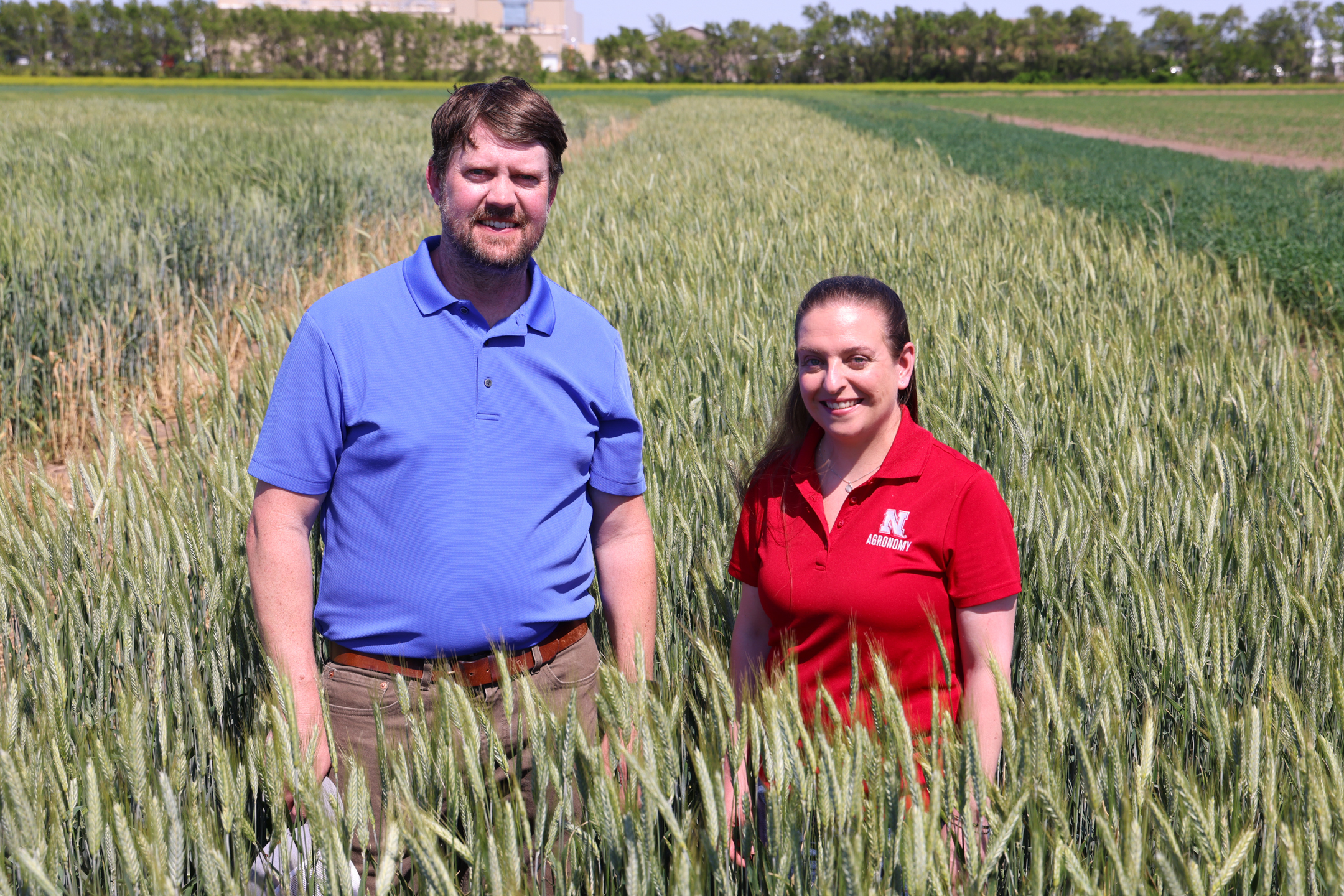
The tours are part of the university’s decades-long collaboration with Nebraska wheat producers dating from the 1950s when Husker small grains breeder John Schmidt developed 28 new wheat varieties. His successor, Stephen Baenziger, continued the tradition, producing more than 40 wheat cultivars. Following his retirement in 2021, Katherine Frels, assistant professor of agronomy and horticulture, is carrying the mission forward.
Success with the new varieties involves not only advanced science and breeding precision, Frels said, but “getting seed increased to the right levels, planning release sequences and making sure that we are filling the right gaps in available germplasm.”
Close collaboration among key partners — the Institute of Agriculture and Natural Resources, Husker Genetics, NUtech Ventures and Nu Horizon Genetics — “has helped us turn these challenges into strengths,” she said. “Together, we are getting the right varieties to the right place at a much faster pace than under our previous capacity.”
Chris Cullan, a fourth-generation farmer in Hemingford, Nebraska, tried Fenster and Daybreak as part of the university’s coordination with growers and said both varieties demonstrated hardiness in enduring the past winter’s significant temperature swings.
“I felt Fenster had great fall growth and ground covering ability. It also just had a healthy color to the plant — a dark, robust green,” said Cullan, who works closely with the university’s Husker Genetics to test new wheat varieties. “The Daybreak I raised was side by side of my Ruth production, and it was very similar in appearance and ground cover last fall, which is good.”
Mueller noted that Fenster has greater height in addition to its updated genetics. As a result, producers can plant a little deeper, and the variety’s late-maturing quality can help growers avoid problems from spring freezing.
Cullan, who collaborates regularly with the specialists and educators at the university’s Panhandle Research, Extension and Education Center in Scottsbluff, cautioned that this year’s crop data will be far from the norm, given the extreme drought conditions in western Nebraska.
The new Fenster variety is named after the late Charles R. “Charlie” Fenster, a longtime Husker dryland farming specialist whose research and outreach helped Panhandle producers achieve notable improvements in wheat management, including soil and water conservation.
Eric Nelson, a fifth-generation farmer near Mead, Nebraska, said Pronto, the university’s new triticale variety, was developed decades ago by Baenziger on an organic farm in eastern Nebraska as he looked for an early maturing, rapid developing triticale to be used primarily as a ground cover.
Pronto, sitting in cold storage, subsequently garnered the attention of Jeff Noel, the now-retired director of Husker Genetics, part of the university’s Agricultural Research Division, which takes experimental plant varieties and hybrids from the lab and grows them into commercial quantities. Nelson tested Pronto repeatedly and found it stands out for a robust early-maturity quality. In partnership with Frels, he developed significant seed volume for sales across Nebraska.
“Its early maturity allows producers who want to hay or chop it, then double-crop behind it,” Nelson said. “They will have the option to grow almost anything they want as their second crop and still have enough growing season left.”
Growers can learn more about the three new varieties here.
The university is achieving important breeding progress through increasingly sophisticated science and technology encompassing high-level genetic science, massive amounts of sensor data and advanced analytical tools to crunch that information.
“The innovation in science is not stopping,” Mueller said. “It’s continuing to progress and succeed, and it’s a whole new world with data and data management.”
Breeders were previously limited to a few datapoints on disease resistance, yield and agronomic performance each year, Frels said. But now the university “has access to high-throughput phenotyping data from UAVs (drones) or other tools in addition to thousands of DNA datapoints on each of our experimental lines.”
Frels and colleagues work to combine that extensive data with traditional selection metrics to make selection decisions efficiently, on time and with better accuracy for the lines’ actual yield potential.
In looking at the university’s multi-faceted support for Nebraska’s wheat sector, Cullan said he especially appreciates the wheat variety testing.
“These real-life trials help to make an educated decision regarding varieties for your specific area of production and in the case of rainfed versus irrigation,” he said.
The resulting multi-year data provide vital, practical information for producers about specific varieties’ long-term reliability.
“That prevents a variety from becoming a ‘one hit wonder’ and having a low term in production years on our farms,” Cullan said.
Share
News Release Contact(s)
Related Links
Tags
High Resolution Photos