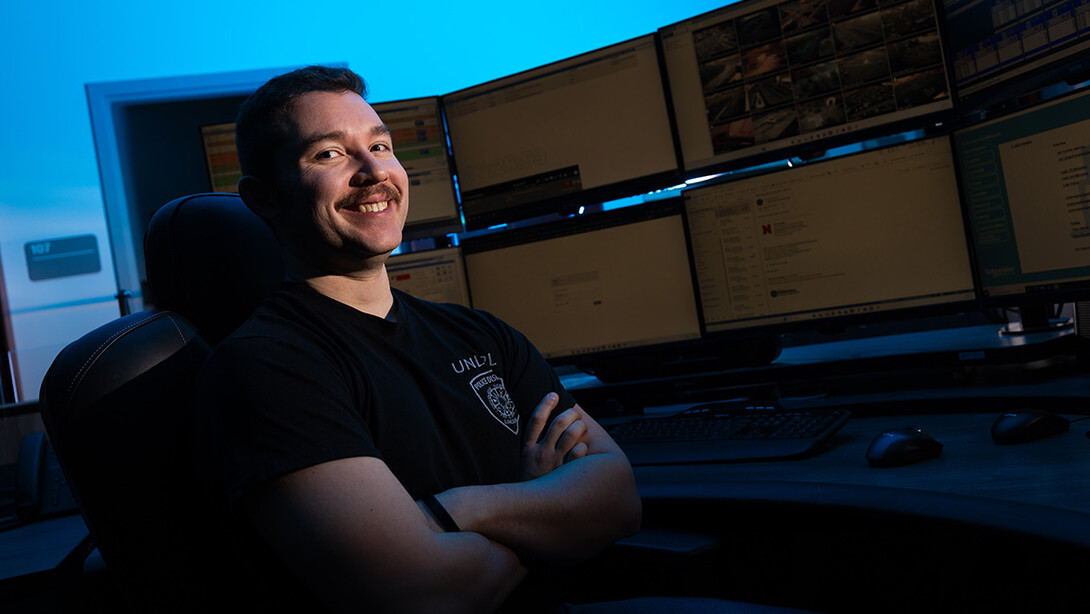
It’s 5 p.m., and campus activity is winding down, but Adam Santee is just starting work. Seated in the University of Nebraska–Lincoln Police Department’s dispatch center, Santee logs in, and eight surrounding computer screens light up, each disseminating critical information.

So begins another evening/night swing shift for the dispatch supervisor. He’ll be on duty until 3 a.m.
“I’ve always been kind of a night owl, but it’s not like staying up late at home,” Santee said. “You obviously have to be much more aware.”
On shift, dispatchers also must remain calm, communicate clearly and find and relay information quickly. Santee loves the work.
“I call it my flow state,” he said. “When a call comes in, I’m able to lock in, my training and experience kicks in, and I’m doing what I need to get the job done, knowing that I’m helping someone, possibly someone who is having their worst day.”
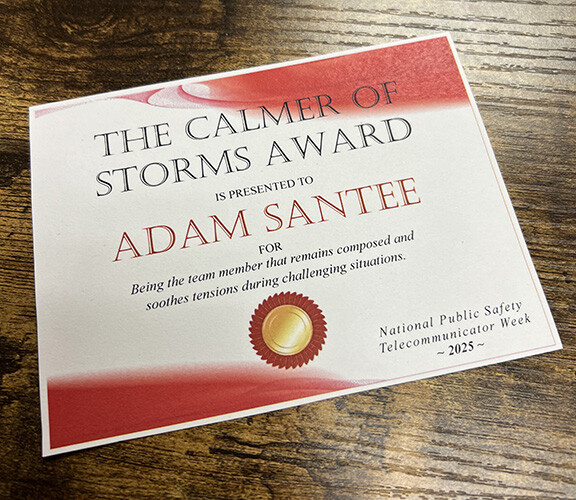
To his colleagues, Santee is affable and steady — there’s an award on his desk, “The Calmer of Storms” — but he admits he grew into the role.
“When I started, I was a nervous nelly, but I had a unique opportunity to learn at a slower pace as a student worker, because I was more of a backup call taker,” he said.
Santee hadn’t planned on a career in emergency dispatch. He couldn’t decide on a major when he enrolled at Nebraska. Interested in law enforcement, he joined UNLPD as a student worker in 2017, which exposed him to the many facets of the department. He quickly found himself drawn to dispatch work. In 2018, he joined the dispatch team full time and was promoted to supervisor in 2023.
In his years with the department, both technology and training have evolved, but one principle remains unchanged.
“In law enforcement, in our training, we really focus on location,” Santee said. “If I don’t know where you’re at, I can’t send help.”
And despite the prevalence of smartphones, callers often still cannot identify where they are.
“Even with the mapping technology we all have, people still can’t always tell us where they are,” Santee said. “Maybe they’re disoriented or surrounded by buildings they’re not familiar with, so we really rely on what we like to call ‘verbal judo,’ which is using every communication skill, observation skill, every possible way of asking to figure out their location.”
No dispatch shift is ever typical, and at UNLPD, the work is more varied than that of many larger emergency communications centers, Santee said. Answering the campus police line at 2‑2222 and re-routed 911 calls is the core responsibility, but dispatchers also assist with recordkeeping, lost property, in‑person customer service, and monitoring dozens of live camera feeds in the center.
Like much of campus, the work ebbs and flows with the academic calendar — and with Husker athletics.
“Fall semester is the busiest,” Santee said. “With new students, all these young kids are trying to adapt to being away from home for the first time and branching out.
“And it’s all hands on deck on game days.”
He knows the field carries a high burnout rate and understands why. But he doesn’t see himself leaving dispatch or the university anytime soon.
“We have unique opportunity here where this department's small enough, our cops often come up to visit after a call, give us a recounting of what their perspective was, and what happened, and I think it's good that we have resolution, that decompression.”
Despite the stress that comes with the job, Santee would encourage it as a career path.
“I think anyone who wants a fulfilling career in law enforcement, but doesn't want to necessarily be front facing, would find satisfaction a dispatch job,” he said. “Knowing that I’ve helped someone at the end of the day is what keeps me coming back.”