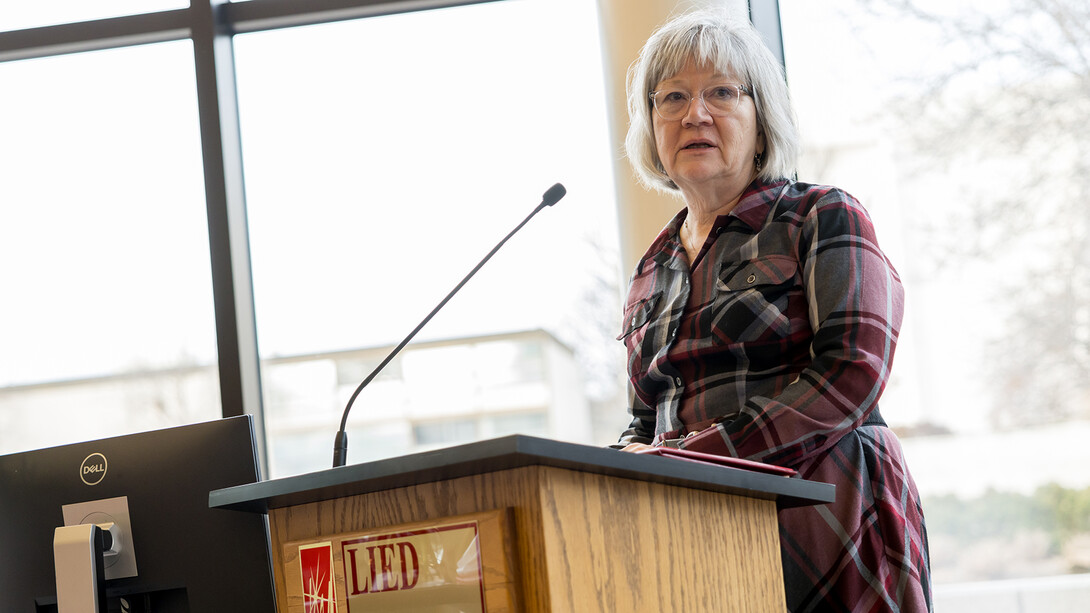
As Leslie Reed prepares to retire after more than four decades telling Nebraska stories — the first 30 in newsrooms across the state and the last 12-plus at her alma mater — we’re pausing to reflect on some of her work that, in her words, demonstrates "why every Nebraskan should be proud of their university."
Reed’s last day in the office is today, Dec. 15, though her official retirement date is Feb. 2. Colleagues are invited to send her an email to lreed5@unl.edu and wish her well in this next phase of life.
Without further ado, here are some career highlights from Leslie Reed, public affairs director for the University of Nebraska–Lincoln.
Know what? The University of Nebraska–Lincoln is a pretty special place. And I’m not just saying that because this is where I got my journalism degree, back in December 1983 (gulp).
As I wrap up my career and head off into retirement, I’d like to hearken back to a few of the projects I’ve worked on that demonstrate why every Nebraskan ought to be proud of their university. Some are inspiring, some are thought-provoking, some are just plain fun.
Prepare to be amazed.
- In 2015, Husker undergraduate Carissa Raymond spotted a fossil while on a dig in New Mexico. It turned out she had discovered a previously unknown species of multituberculate mammal.
- Speaking of new species: Scientists and engineers with the Nebraska-led ANDRILL program discovered a species of small sea anemones that live burrowed in the underside of Antarctica’s Ross Ice Shelf.
- Scott Gardner, director of the H.W. Manter Laboratory of Parasitology, led a research team that identified four previously unknown species of Ctenomys, a gopher-like mammal found in South America.
- Huskers make the world a healthier place. A research team led by Eric Weaver, director of the Nebraska Center for Virology, developed and tested a new vaccine strategy that protects against swine, human and bird flu — a step toward a universal flu vaccine.
- Political scientists Kevin Smith and John Hibbing taught us that political beliefs arise from the body and the mind.
- During the COVID pandemic, faculty members Hunter Flodman and Terry Howell partnered with the Nebraska ethanol industry to prepare and supply hand sanitizer to USDA meatpacking inspectors and the health care sector.
- UNL leaders quickly stood up a campuswide COVID testing system that hastened the return to campus.
- Huskers love history. Students with UNL’s Tractor Restoration Club fixed up a 1945 Allis Chalmers C tractor used by the nation’s last homesteader so it could go on display at the Homestead National Historical Park near Beatrice.
- Willa Cather gained renewed attention when her sculpture was unveiled in National Statuary Hall in Washington, D.C., in June 2023, highlighting UNL’s nationally leading research on the beloved author’s life and work.
- As the centennial of World War I Armistice Day approached, journalism professor Barney McCoy produced a documentary aired by NET Television about General John J. Pershing that revealed little-known details of Pershing’s life.
- Art history professor Michael Hoff has led archaeological expeditions that uncovered historically significant mosaics and other aspects of Antiochia ad Cragum, a city established in Turkey in the first century but abandoned by 1071.
- Students do big things at the University of Nebraska–Lincoln. This past year, undergraduates Avery Marquis, Vanessa Hubing and Chanasei Hubing co-authored two research papers detailing how the human immune system evolved.
- Raikes School students Kenny Morales and Wilson Overfield won a pitch contest for a smartphone app that can help students match with the perfect college for them.
- Nebraska has been at the forefront of digital humanities — using computer technology to better understand society. Matt Jockers, then a Nebraska English professor, used the Tusker supercomputer to analyze 4,500 English-language novels to help explain why some books become bestsellers.
- Nebraska faculty have used drones for everything from journalism to tornado research to precision agriculture. Faculty members Carrick Detweiler, Sebastian Elbaum and Dirac Twidwell collaborated to create fire-starting drones that could be used for controlled burns to stop the encroachment of Eastern red cedar into Nebraska grasslands.
- Nebraska Engineering leads the way with robotics. In one example, a group of surgeons on the ground in Lincoln used controllers to operate a surgical robot aboard the International Space Station. Nebraska’s Shane Farritor led the design of the robot and is a partner in a company commercializing it. The surgeons only used the robot to cut rubber bands, but their enthusiasm and concentration rivaled that of the most intense video gamers.
This is only a sampling of the topics I was blessed to learn about since joining the university. 2D materials, precision agriculture, HIV research, neuroscience, milk exosomes, national champion debaters and national champion soil judging were among many others.
This job has allowed me to interact with many fascinating and brilliant people — faculty, staff, students and administrators. I’ve been inspired by their commitment to this institution, to helping Nebraskans lead full and satisfying lives, and to increasing the body of knowledge. Nebraskans and the world should know why the University of Nebraska matters.