It just got a little easier to be green.
Utility and Energy Management recently unveiled the online energy management portal, allowing university community members to assess their building’s energy consumption, all from the convenience of a desktop or smartphone.
“We want building occupants to have greater awareness of their energy consumption,” said Ted Weidner, assistant vice chancellor of facilities, management and planning. “They don’t need to know the details about every piece of academic equipment, but understanding how the combined consumption affects total energy consumption is important.”
Auxiliary buildings, such as residence halls and unions, are billed for their energy use each month. Since they know approximate monthly costs, they have built-in incentives to curb consumption.
Academic units, however, depend on state budgets to pay for their energy bills.
“This has allowed academic units to be largely oblivious to the cost of their energy and the fiscal impacts of building operating decisions,” said Kirk Conger, mechanical engineer and energy projects manager.
The Department of Energy estimates that three percent of energy savings can take place just by installing meters that gauge energy use within buildings.
At the Big Ten and Friends Mechanical and Energy Conference held last month at Purdue University, UNL collaborated and exchanged ideas about energy efficiency with other schools in the conference.
“We like to think our plans are ahead of the other campuses because we’re the only campus in the Big Ten to have all buildings metered,” Weidner said. “As a result, we have a leg up on them and have been able to create a meaningful energy portal to inform the campus about energy consumption.”
With the meters already installed, the creation of the portal was the next step toward igniting energy awareness among the university community.
“Our goal with this portal was to provide a lot more information about campus utilities to our own campus and others who had an interest,” Conger said.
The portal features information on current energy conservation projects, utility infrastructure, building controls and utility bills.
“An individual turning his or her computer off each night will not be able to see the impact on the monthly bill,” Conger said. “But if every person does that, it adds up.”
The portal also details UNL’s Campus Energy Management Plan, which sets the primary goal of reducing university energy use by three percent per year for the next five years.
“That will require a combination of building and equipment improvements, smarter controls and behavioral changes by the campus community,” Conger said. “Our energy use (per square foot) has trended downward for a number of years, but rising energy prices and a growing campus have increased our actual utility costs over that time.”
Utility and Energy Management plans to add another page to the portal that illustrates the cost of providing energy to the campus, a monetary figure that will be updated hourly.
“It will be an eye-opening number,” Conger said. “We have to install additional, complicated metering equipment at several points in the system to make that a reality, but we’re working on it now.”
Conger said that although he doesn’t expect everyone to check their building’s energy use on a regular basis, having the information available for them to access is a step in the right direction.
“Building operating decisions and individual behaviors all contribute to UNL’s energy bill,” he said.
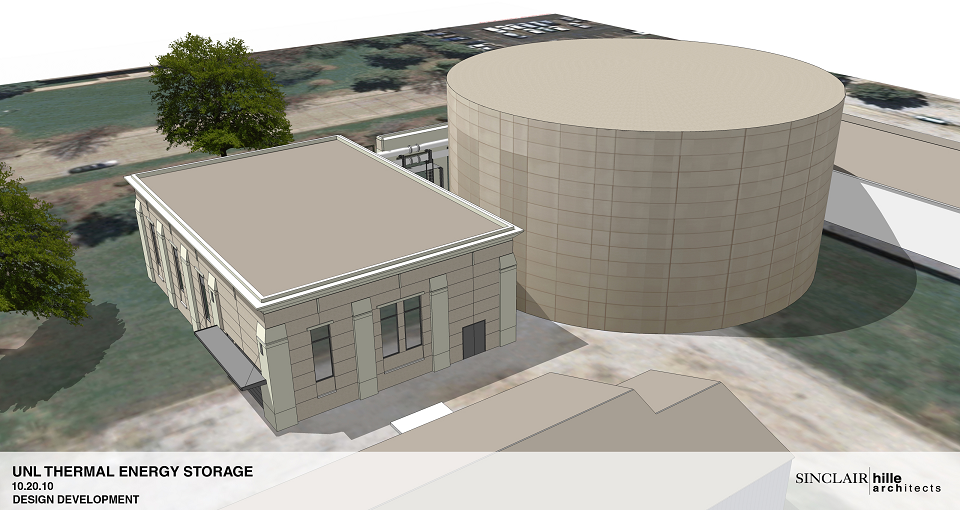
One such building operating decision that’s underway is the development of a thermal energy storage tank on East Campus.
The tank will produce excess cold water – circulated to campus buildings to provide air conditioning – at night, when electricity prices are lowest. The water will then be stored in the insulated tank for use during hot afternoons.
“For large users, a significant portion of their electric bill – sometimes half – is based on when they use a lot of electricity, rather than how much is used,” Conger said. “(With the tank) we can reduce our peak electric demand and avoid using as much electricity during the highest-cost periods.”
Originally, Utility and Energy Management proposed adding chillers on East Campus to deal with the university’s growing peak cooling needs.
The proposal to add chillers was axed due to high installation expenses, which led the unit to envision the more cost-effective tank.
“The tank is a better solution because we are able to avoid adding a lot of expensive equipment and avoid constructing a major building to house the equipment,” Weidner said.
Currently under construction, the tank is slated for completion in May 2012 and will begin operating by June, just in time for the cooling season.
“As with any effort, energy conservation at UNL is the result of many people working in many important and sometimes small ways,” Weidner said. “The more people who understand and become involved in energy conservation, the more significant the result.”
To check out your building’s current energy consumption levels, visit the portal at http://uem.unl.edu/energy-management/portal.shtml
— Mekita Rivas, University Communications