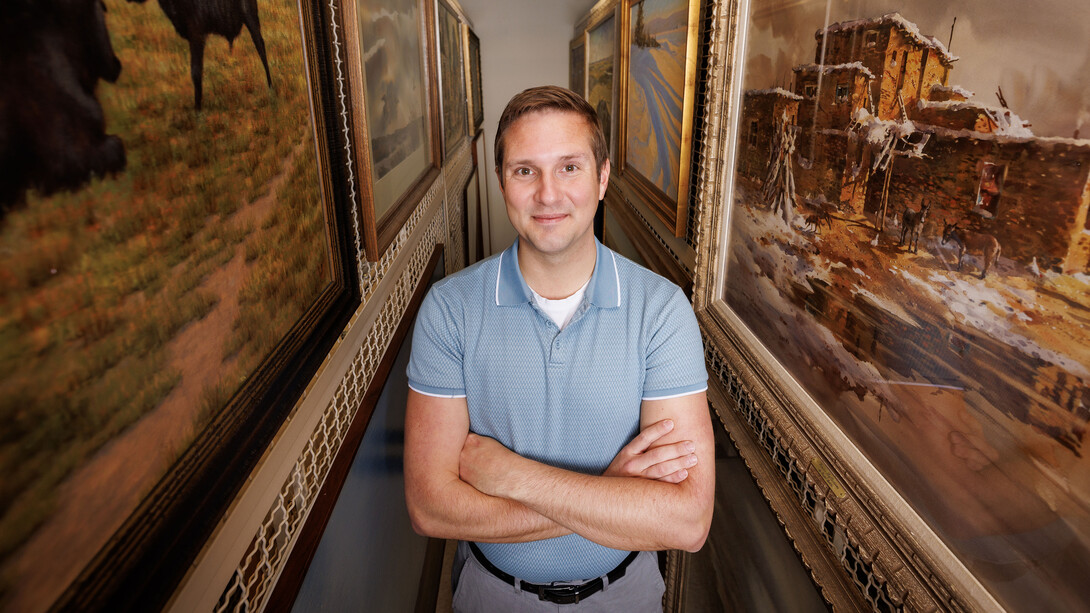
Casey Seger-Franklin’s career has taken him from one end of the Great Plains to the other — and his current work places him at the heart of preserving pieces of the region’s history.
Seger-Franklin, collections manager at the Great Plains Art Museum and Center for Great Plains Studies, brings a background in history to protect, record and share cultural history of the region. His connection to the Great Plains and its stories encompasses the land and all its people, prominent or otherwise.
“It’s important to have the everyday person’s information and experiences preserved for future historians to get a fuller picture of what life in our time was like,” Seger-Franklin said. “A lot of history is uncovering some of that everyday life that is not well known to us because that information doesn’t survive to us. Gaining that everyday aspect is something I’m passionate about carrying on.”

Seger-Franklin, a Nebraska native, always felt connected to the Great Plains. His interest in museums started at a young age, when he had the opportunity to visit major museums in Europe as a teenager. As an undergraduate, he worked at the South Dakota Art Museum and then at the Museum at Texas Tech University as a master’s student. He then accepted a position in Deadwood, South Dakota.
“I’m always very curious about how things happen and how we get from point A to point B,” Seger-Franklin said. “It was great to see museums as a physical place where you could go to learn about these tangible and intangible parts of history. You could see the paintings that depict greats of history or you could read the letters of noblemen and in some cases, the everyday person. That’s the part that got me intrigued — being able to connect where we’re in the present with what had gone on in the past.”
He arrived at the Great Plains Art Museum about eight years ago. His early experience working behind the scenes with collections fascinated him. Preservation and conservation work allows Seger-Franklin to be part of documenting and sharing the stories of the art.
“That’s information that needs to be passed on that people should know about,” he said. “Being able to preserve that information for future generations was the part that I was most excited about.”
Seger-Franklin’s daily work ranges from exhibition installation to collections care to database management and acquisitions to assisting with educational programming.
A large part of his job at the Great Plains Art Museum revolves around work by Native artists. Seger-Franklin said he has long been interested in learning about the culture and lifeways of the region’s Native tribes because it was a topic he didn’t feel was taught much when he was in school. He’s relished the opportunity to speak with and learn from members of regional tribes.
“Being able to reconnect those communities with their cultural items and even life stories is a great undertaking that’s changing now in museums,” he said. “I love getting to meet with members of tribal museums. We have a lot of contemporary art where a lot of the symbolism is rooted in traditions that are part of tribal cultures, so (I can learn) why an artist might have depicted a dancer a certain way.”
Seger-Franklin’s work also gives him the opportunity to share all of this history through class visits and other educational programming. Specifically, visits to meet with the annual Elizabeth Rubendall Artist-in-Residence. That program invites an artist to lead educational events and create an original artwork for the museum’s collection.
“It’s a great partnership with the Elizabeth Rubendall Foundation and it is a great opportunity for us to bring in artists that we might not be able to afford to host on our own, and it allows us to get a more diverse scope in the collection and what it means to be on the Great Plains,” Seger-Franklin said. “Most people might come to us with the impression we have a lot of landscape art, and we get to invite people into the artist-in-residence program who might have a particular view on a topic that is important to the Great Plains.”
The program also fosters a collaboration between the university and area school groups, which often sends students to the museum for programming with the artist. Seger-Franklin said he hopes the encounters inspire students to pursue their own artistic endeavors.
“We show them the artmaking process because we have a studio right here where we can have the artist work and people can see the art in process and know they got to see the art being created before it becomes part of the collection and engage with an artist who is actively creating an artwork and get to learn more about their style and their craft,” he said.
In addition to his daily work, Seger-Franklin has been a member of the Staff Senate for almost two years. He aimed to connect all levels of staff with administrators.
“It’s always been a passion of mine to be an advocate for staff members, whether they’re the custodian or the administrative associate or wherever that position might be,” he said. “It takes everybody to run the university, so I thought it sounded like a good way to give back and be a voice for people who might not have the opportunity to represent staff.”
Maximizing the employee benefits package has been a major priority for Seger-Franklin, who sits on a salary and benefits task force.
“There are new, creative ways to leverage resources that could be a benefit to staff,” he said. “We’ve made some progress with that and I think we’ll continue to make good progress due to the good communication channels we have.”
Seger-Franklin’s goal with the position is to bring ideas and concerns from staff to administrators in the hopes of building a better workplace for all.
“Staff Senate is a good way to let higher level administrators know what is going on with boots on the ground,” Seger-Franklin said. “It’s always great to have the reminder there is this avenue for communication and cooperation, to hear from people directly. People who don’t necessarily have the opportunity to serve can make their thoughts and opinions known and know they’re going to get passed on to the highest levels and not get lost.”