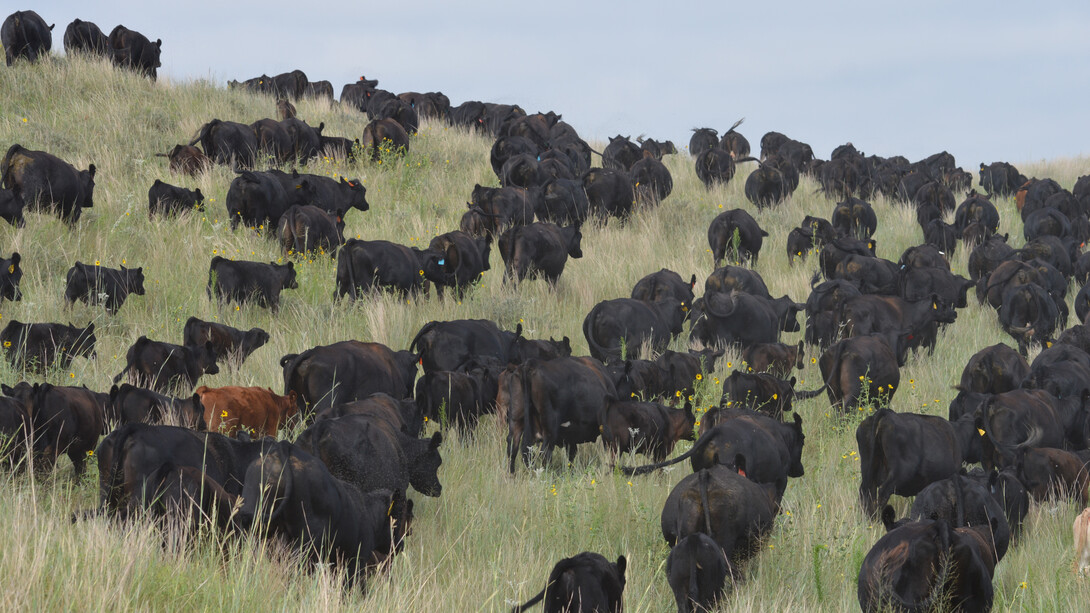
University of Nebraska–Lincoln faculty are at the forefront of animal welfare research and will host a June 1-3 international symposium highlighting the latest research and practical applications for beef cattle.
“There is a clear and growing need for collaboration across disciplines and sectors, and this symposium aims to address that need in a very intentional way,” said Ruth Woiwode, who has pioneered the university’s animal welfare studies as an assistant professor of animal science.
Woiwode, who is also an animal behavior and well-being specialist with Nebraska Extension, is co-chairing the symposium along with Brian Vander Ley, a veterinary epidemiologist and extension specialist with the School of Veterinary Medicine and Biomedical Sciences, and director of the Great Plains Veterinary Education Center.
The International Symposium on Beef Cattle Welfare, founded by a cooperating team of U.S. and Canadian animal scientists and veterinarians, is a biennial event hosted in rotation by partner institutions in both countries. The 2026 symposium, to be held at the Nebraska East Union, will feature the theme “Bridging Research and Practice for the Future of Beef Cattle Welfare” and include talks, roundtables and panels discussing practical tools, research findings and the trajectory of beef cattle welfare management.
Registration is underway, and the full program is online, with presentations scheduled from a range of experts from academia and industry.
Discussions on beef cattle welfare often take place within the separate professional communities for packers, veterinarians and producers.
“As a result, many of the conversations shaping animal welfare are occurring in parallel rather than in a shared space,” Woiwode said.
She and other organizers have structured the symposium to promote cross-sectional discussion by focusing on shared challenges and dissemination of ideas across disciplines and sectors.
IANR is well positioned to contribute to this effort given its livestock infrastructure, applied research and extension outreach. A key strategic investment is the Klosterman Feedlot Innovation Center near Mead, Nebraska, featuring enclosed feeding facilities, open pens, a handling barn with classrooms and a 240-head capacity high-tech feed facility. Those facilities enable advanced research regarding individual animal responses to feed, cattle comfort/health and environmental management.
Nebraska speakers at the symposium include Tiffany Heng-Moss, Harlan Vice Chancellor for the Institute of Agriculture and Natural Resources; Tom Field, Paul Engler Chair of Agribusiness Entrepreneurship; and Paxton Sullivan, technical services manager with Sustainable Beef LLC, a $400 million, rancher-owned beef processing plant in North Platte that opened in 2025 and processes about 1,500 cattle per day.
Through agreement with the American Registry of Professional Animal Scientists, the symposium will provide 13 hours of continuing education for the group’s members. Organizers are in the process of securing accreditation for North American veterinarians to receive continuing education credit.
As a U.S.-Canada endeavor, the symposium exemplifies the close economic and research connection between the two countries regarding cattle.
Longstanding research programs in Canada have played a significant role in advancing beef cattle welfare science, Woiwode said. At the same time, industry partners operating across both countries are contributing to the development and implementation of new technologies and management approaches.
Emerging ventures such as Blackshirt Feeders in western Nebraska, supported in part by Canadian investment and connected to the university, illustrate how closely aligned these systems have become in practice, bringing together veterinarians and production leaders with experience across both U.S. and Canadian cattle systems. Participation from groups such as Telus Agriculture further reflects the growing integration of data, research and production.
As for the future, Woiwode said, “while the field is increasingly adopting integrated, data-informed and systems-based approaches to animal welfare, long-term progress will depend on how effectively we understand and support the human component — including training, decision-making and workforce development.”
The symposium aims to strengthen the connections between research and practice and facilitate long-term collaboration across sectors and regions.
“The future of this work is not only about advancing science and practice, but also about sustaining the community and infrastructure needed to support it,” Woiwode said. “Events like this symposium play an important role in creating that continuity, aligning priorities and maintaining momentum over time.”
Share
News Release Contact(s)
Related Links
Tags
High Resolution Photos
HIGH RESOLUTION PHOTOS