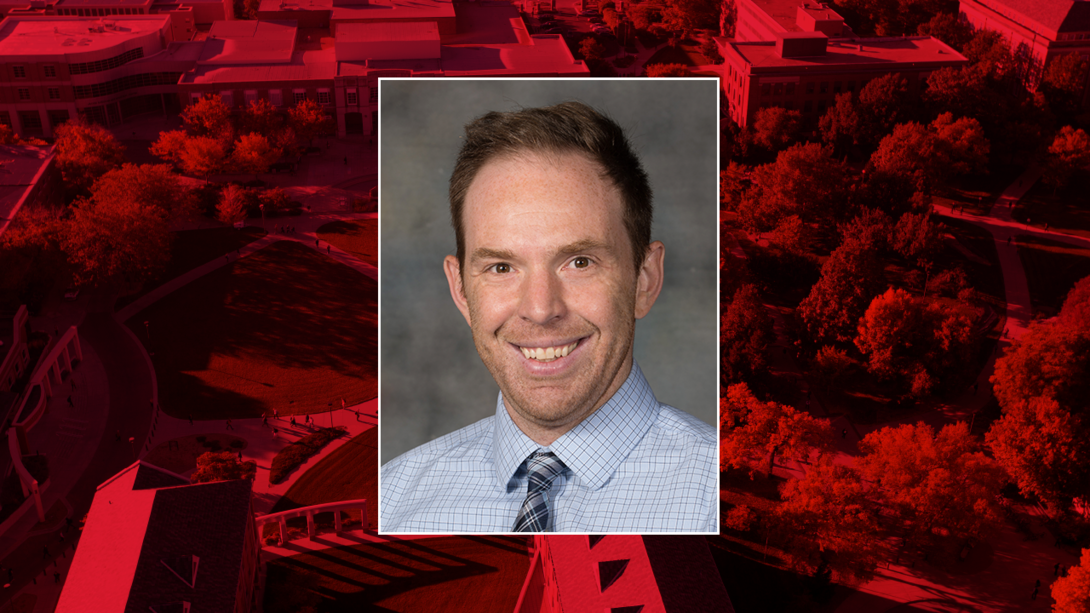
A new public history project by University of Nebraska–Lincoln historian and religious studies scholar Max Perry Mueller is reimagining how Americans think about the nation’s founding — one decade at a time.
"More, America" is a weekly series that profiles 25 overlooked “founders” of the United States, stretching from the 1770s to the 2020s. Released one essay per week through July 4, the project culminates on the nation’s 250th anniversary and offers an alternative to uncritical celebrations of American history.
Rather than focusing on the familiar cast of revolutionary-era elites, "More, America" asks a different question: Who has actually made America over time? The series highlights figures who shaped the nation through resistance, reform, cultural creation and moral critique, often from its margins.
“Founding isn’t something that happened once in the 18th century,” Mueller said. “It’s something Americans have argued over, fought over, and reimagined in every generation since. 'More, America' treats later struggles for justice, sovereignty and belonging as acts of founding in their own right.”
So far, the project has featured a wide range of figures who complicate and expand the traditional founding narrative. The 1770s essay centers on Phillis Wheatley, the enslaved poet who pressed revolutionary ideals of liberty and equality through verse steeped in classical learning and Christian theology, exposing the moral contradictions of a nation built on both freedom and bondage. The 1780s installment examines Mohawk siblings Joseph Brant and Molly Brant, influential diplomats who rejected U.S. claims to Indigenous consent and forced Britain and the United States to reckon with Native sovereignty after the Revolution.
The 1790s profile focuses on Judith Sargent Murray, the essayist and political thinker who argued that the American Revolution remained unfinished without women’s intellectual equality. The 1800s essay turns to Tenskwatawa, the Shawnee Prophet and religious visionary whose call for moral renewal and spiritual sovereignty helped animate Indigenous resistance to U.S. expansion. The 1810s entry highlights Mordecai Manuel Noah, a Jewish journalist and diplomat whose public career tested the promise of American religious liberty by insisting that Jews could be fully Jewish and fully American.
Each essay functions as a stand-alone profile written for a broad public audience and grounded in historical scholarship. Read together, the pieces form a sweeping reinterpretation of U.S. history that treats founding as an ongoing, contested process rather than a closed chapter.
The project is also explicitly participatory. Mueller hopes readers will challenge his selections, debate what counts as “foundational,” and propose their own candidates for inclusion.
“This isn’t meant to be a final list,” Mueller said. “It’s an invitation to argue about power, memory and whose actions we treat as nation-shaping.”
"More, America" builds on Mueller’s broader body of scholarship, including his book, "Wakara’s America: The Life and Legacy of a Native Founder of the American West." He is also developing the series into a book-length manuscript.
Mueller hopes the project will be used in classrooms, reading groups and public discussions leading up to July 4.
“Anniversaries can flatten history or open it up,” Mueller said. “My hope is that 'More, America' encourages people to see the United States not as a finished project to be defended, but as an unfinished one —s till shaped by whose stories we tell, and whose we leave out.”
"More, America" is published weekly and is freely available to the public.