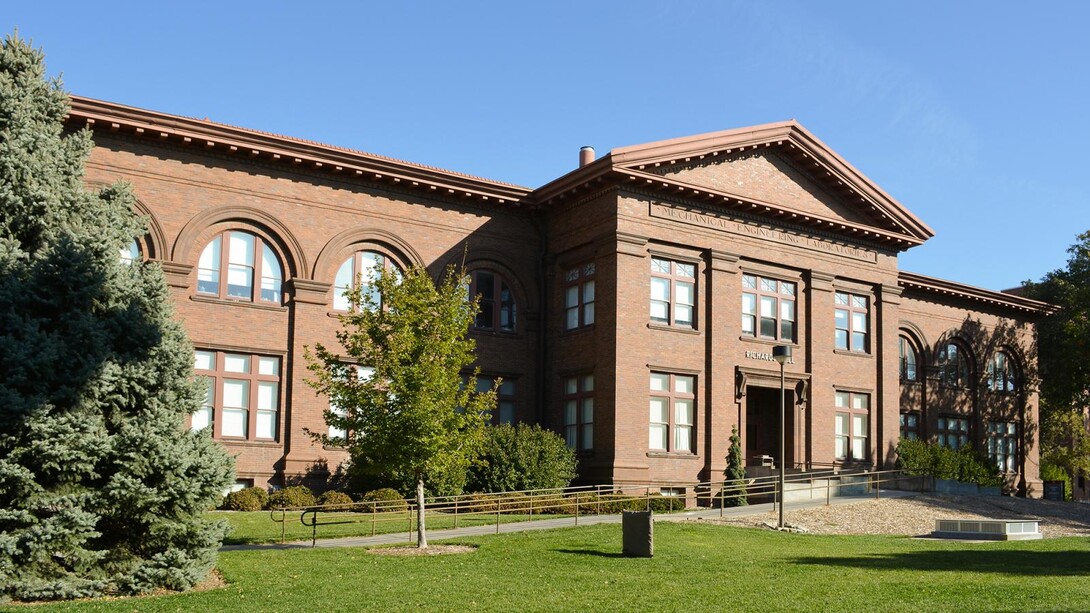
“Exposition Exhibition: Art and the 1898 Omaha World’s Fair” will be on display in the MEDICI Gallery in Richards Hall, Dec. 15-19.
The exhibition, created by students in 19th century American Art taught by Wendy Katz, professor of art history, revises, revisits and reimagines the Trans-Mississippi Exhibition.
The 1898 International Exposition in Omaha drew more than 2.5 million people, including President William McKinley and members of 35 Indigenous tribes.
“I think students came into the class feeling like this was a pretty ’niche’ subject in art history, but they quickly grasped the ways in which the categories created for art and culture in the 1890s are still determining university, museum and market decisions today,” Katz said. “I was proud of the thoughtful way that they engaged with and tried to understand the people and artists of 1898, though their views were so different than theirs. Their artwork is based on their research into objects (photos, souvenirs, artworks et al.) from the 1898 exposition, but it expresses their own understanding of why the exposition still matters.”
The exhibition is curated by graduate students Toni Parker, Kerry Eddy and Jalen DeCoteau. Graduate student Madeline Butkovich is designing the graphics. Sixteen undergraduates are contributing artworks, and the other 14 students are writing papers.
The exhibition showcases projects that explore concepts and ideas inspired by at least three specific objects or visual materials from Omaha’s Trans-Mississippi and International Exposition.
Eddy, a second-year graduate student in studio art (painting and drawing), said the exhibition will include a wide range of projects, including her own video on technology in which she reimagines several exhibits of the Trans-Mississippi Exposition in the context of a 21st century exposition.
“We have an amazing, insightful group of students who have chosen intriguing exhibits of the Trans-Mississippi International Exposition that they have taken an in-depth look at. Each student who has chosen to create works to reflect their research findings has a unique perspective,” Eddy said. “We have printmakers, ceramicists, sequential artists (comic books), painters, sculptors, digital artists/animators, and graphic designers. I am looking forward to seeing what everyone has created and reading some of the research papers.”
Eddy said the exhibit will bring to light a little-known piece of Nebraska and Omaha history through an in-depth examination of this important event.
Ellie Nelson, a junior art history and studio art major, is creating dioramas of the Fine Arts Building and the Liberal Arts Building to include what was in each of them, including "high art" and applied art. Nelson said she found it interesting how the fair defined “art” and "culture" into two different categories—industrial innovation and aesthetic refinement.
“What I hope people get from the dioramas is an understanding of how the 1898 Omaha Exposition used art and architecture to define progress in two competing ways," Nelson said, "one rooted in beauty and culture through the Fine Arts Building, and the other in productivity and modernity through the Liberal Arts Building, both reinforcing America’s vision of itself as a civilized, advancing nation.”
Amy Xu, a senior art major from Omaha, is contributing an artist book on Asian art. The class visited the University of Nebraska–Lincoln Libraries Special Collections, where they viewed artifacts from the fair.
Xu said she thought a World’s Fair was about new inventions and had no idea there were also reenactments.
“At an exhibit called ‘Moorish Palace,’ there were many reenactments from a detailed labyrinth and Biblical scenes to a fake execution of Marie Antoinette,” Xu said. “This blended emphasis of the past while looking to the future was a fascinating and unexpected combination. While exhibits were meant to be realistic and informative, it also ended up as misinformation and racist ideals being presented.”
Claudie Villegas, a senior art major from Omaha, is creating a two-sided coin. One side will be hand-beaded, and the other side will have watercolor. She said the whole idea for her project revolves around Native American culture during this time and what that looked like to non-native people.
“Beading is a big part of Native American culture, so I really wanted to incorporate that,” Villegas said. “My mother had been making beaded earrings for a long time as well, so I thought this would be a good opportunity to learn from her and spend time together. The backside will be watercolor. I’ll take a watercolor-safe paper that I painted a design on and put that on the backside of the beaded side.”
Anabella Kerans, a senior art history and psychology major, is contributing a research paper on the development of Kountze Place in North Omaha. She said she found learning about the Trans-Mississippi Exposition to be intriguing.
“I came into this class with almost no knowledge of the Trans-Mississippi Exposition, but through the process of the class, I feel that I have learned more than I ever thought I would," Kerans said. "Having come from Omaha, I feel as if I have uncovered a hidden aspect of my home. The exhibition will be an incredible learning opportunity for all those who choose to visit.”
Nelson said visitors to the exhibit should expect to see a wide variety of projects using different materials and showing different aspects and concepts surrounding the exposition. Xu encourages people to come to the exhibit to learn about the Trans-Mississippi Exhibition and see the pieces students chose to focus on and study.
In examining the legacy of the exposition, Nelson said the fair’s impact is still felt today. Nelson said this experience has reshaped the way she thinks about the past and its influence on the present.
“What I’ve gained from this experience is a deeper understanding of how historical events shape the way we view culture, identity and representation today,” Nelson said. “It has also encouraged me to approach historical and cultural materials with more critical thinking, as well as a more informed and empathetic perspective.”